
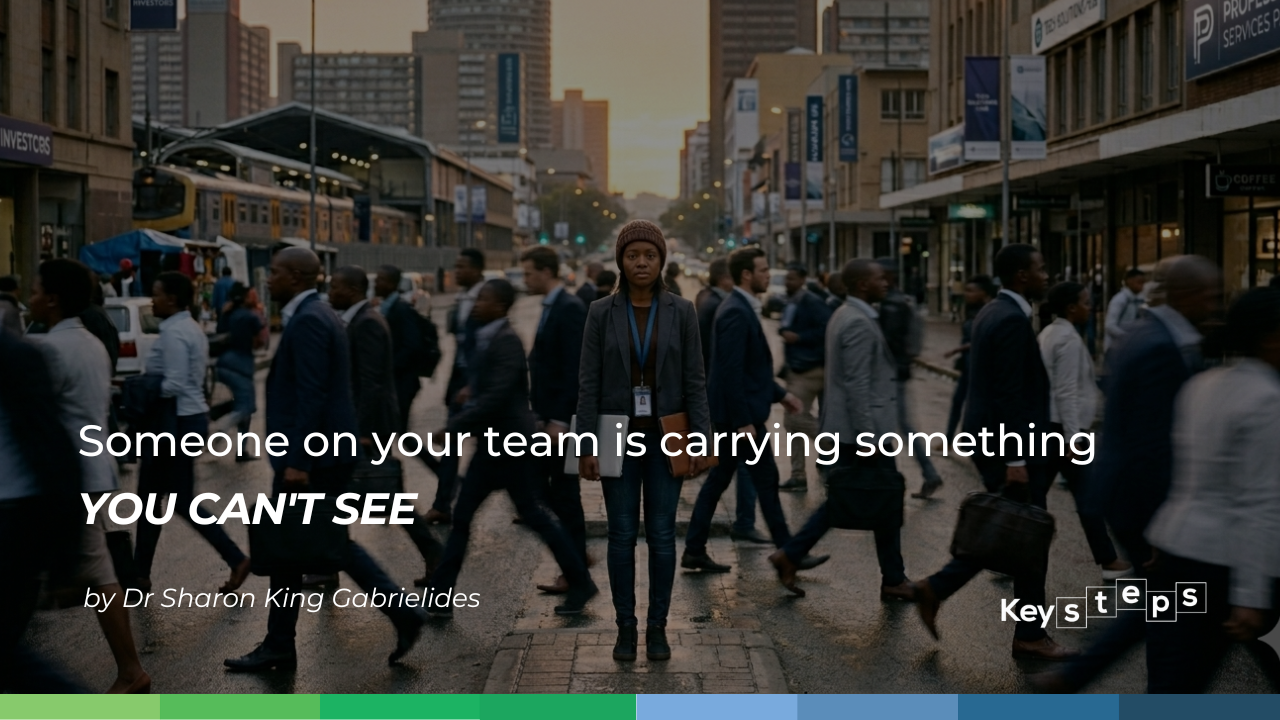
Many are carrying invisible loads – psychological safety has never mattered more.
a
Some months ask more of you than others. I’ve had several of those months – and I want to share why, because I think it matters beyond my own story.
Some months ask more of you than others. I’ve had several of those months – and I want to share why, because I think it matters beyond my own story.
Recently, I was diagnosed with a rare autoimmune condition. It arrived quietly and without warning, in the midst of a life where, by every measurable standard, I am the picture of perfect health. I eat well, I exercise and my annual check-ups are always spotless. That is the nature of autoimmune disease: it doesn’t discriminate and it doesn’t wait for a convenient moment. Research suggests these conditions now affect up to one in twelve people, most diagnosed in mid-life, often completely out of the blue.
I’m not sharing this for sympathy. My condition is not life threatening, and I’m blessed to be able to afford the right doctors and the cocktail of medication that it takes to successfully manage this condition. I share it because sitting with my own diagnosis – and hearing so many friends and clients going through such tough stuff – it has brought something into sharp focus that matters deeply to the work I do with leaders and teams every day.
It’s likely that many people in your meetings are carrying something you cannot see. And that changes everything about how we must lead.
What the neuroscience tells us
The brain does not distinguish cleanly between physical threat and psychological threat. The same circuits that activate when you are in physical danger – causing the stress-response cascade, the cortisol surge – also activate when you feel unseen, unsupported or unsafe in your environment.
When someone is managing chronic illness, family crisis, financial pressure, grief or the invisible weight of simply not being okay – their nervous system is already partially occupied. The prefrontal cortex – the brain’s seat of strategic thinking, creativity, emotional regulation and complex decision-making – has reduced bandwidth available. Not because the person is less capable. But because the brain has already allocated significant resources to managing what is happening beneath the surface.
Here is what this means in practice: the person sitting quietly in your meeting, needing an extension on a deadline or not speaking up in the brainstorm – may not be disengaged. They may be exhausted in ways you cannot measure.
I want to be clear about something, because I know what leaders fear when they read this – this has been a deep fear of mine too… This is not an argument for lowering standards or excusing underperformance. It is an argument for understanding what actually drives performance – and what silently erodes it. A nervous system that feels unsafe, unseen or chronically overwhelmed cannot access its full capacity regardless of how talented the person is. Creating psychological safety is not about removing accountability. It is about removing the unnecessary cognitive tax that prevents people from giving you their best. The most psychologically safe teams are not the ones with the lowest standards, they are consistently the highest performing ones, because people bring their full thinking rather than a defended, self-protective version of it.
Psychological safety is not a nice-to-have. In the neuroscience of performance, it’s oxygen. Let’s explore how to do this practically and take Key Steps to…
‘be the difference that makes the difference.’
Assume burden before you assume poor behaviour.
When someone’s performance or presence shifts, the instinctive leadership response is often to address the behaviour (and that’s not wrong, it’s just premature). Neuroscience and emotional intelligence both invite us to ask first: What might this person be carrying that I cannot see?
This is not about lowering standards. It is about widening your lens before you narrow your response. A simple, private check-in, “I’ve noticed you seem a little quieter lately. How are you really doing?” can be the difference between someone feeling seen and someone feeling managed.
The brain relaxes when it feels safe. And people do their best work when they are not spending cognitive energy managing their own fear of being judged.
Make it safe to say, “I need support” or “not now.”
One of the most psychologically costly things we ask of people is to perform at full capacity regardless of what is happening in their lives. Yet most workplace cultures have no language, no permission structure and no psychological container for someone to say, “I am not at my best right now. I need support.”
Create explicit permission. Model it yourself. When you are depleted, say so. When you are sick and need time to really recover, take it. When you have reduced capacity, name it. The leader who says “I’m carrying something this week – I may need to think out loud with you rather than come with the answer” gives every person in that team permission to be human.
This is not weakness. This is what Amy Edmondson’s research consistently shows creates the highest-performing teams: Environments where the cost of honesty is low.
Regulate yourself first.
You can’t co-regulate others if your own nervous system is dysregulated. When leaders are under pressure, stressed or overwhelmed – and hide it behind urgency, impatience or over-control – that neurologically state is broadcast to everyone. Mirror neurons mean your team literally feels your internal state, even when you don’t say a word.
The most important leadership practice I know, and one I’ve been so grateful for this year – is the pause. One conscious breath before a difficult conversation. A moment of grounding before a meeting. Five minutes of quiet between back-to-back demands. These are not luxuries. They are the micro-habits that keep the prefrontal cortex online and prevent us from becoming the source of threat in someone else’s already-pressured day.
Slow down to connect and find out.
In a world of relentless pace, the most radical leadership act may simply be to ask, “How are you – really?” followed by silence. Genuinely wait for the answer. No rushing to solutions. No pivoting to tasks. Just presence.
The nervous system needs time to assess whether it is truly safe to be honest. If you ask the question and immediately move on, the answer you get will likely be some version of “fine.” If you ask and you wait with your eyes on the person, phone away, body open, the real answer has a chance to emerge.
Psychological safety is built in these small, unhurried moments. Not in policy documents.
The question is not whether people are struggling. The question is whether your leadership makes it safer – or harder – for them to carry it while they are with you.
Remember that resilience is not the absence of struggle – and built before the crisis.
One of the most damaging myths in high-performance culture is that resilient people don’t struggle. They do. Deeply. They simply have access – through awareness, support and safe environments – to the internal and relational resources needed to keep moving.
When my diagnosis came, one of my doctors gently suggested I consider getting some psychological support. I appreciated the care behind that suggestion. And I had to smile quietly to myself because I have been attending to my own psyche for over 28 years. Therapeutic support, coaching, deep inner work. Not because something was wrong with me, but because I understood early that to do the work I was born to do my inner life needed tending just as deliberately as the physical one. That investment is a significant part of why I can carry what I do without being undone by it.
Resilience is not something you find in a crisis. It is something you build before one arrives. And it is built in the quiet, consistent work of knowing yourself – seeking support, staying curious about your own patterns and refusing to treat your inner world as an afterthought. It has to be your top priority.
That is the invitation I am sitting with this month. Not to be the leader who demands performance regardless of the human cost. But to be the leader who creates the conditions in which struggling humans can still think well, still connect and still contribute – because they feel safe enough to be honest about where they are.
That kind of leadership is what I believe will define the next era. And it asks something of us that no framework or model can fully prepare us for. It asks us to be human. First.
And from that place – to take Key Steps to…
‘be the difference that makes the difference.’

