
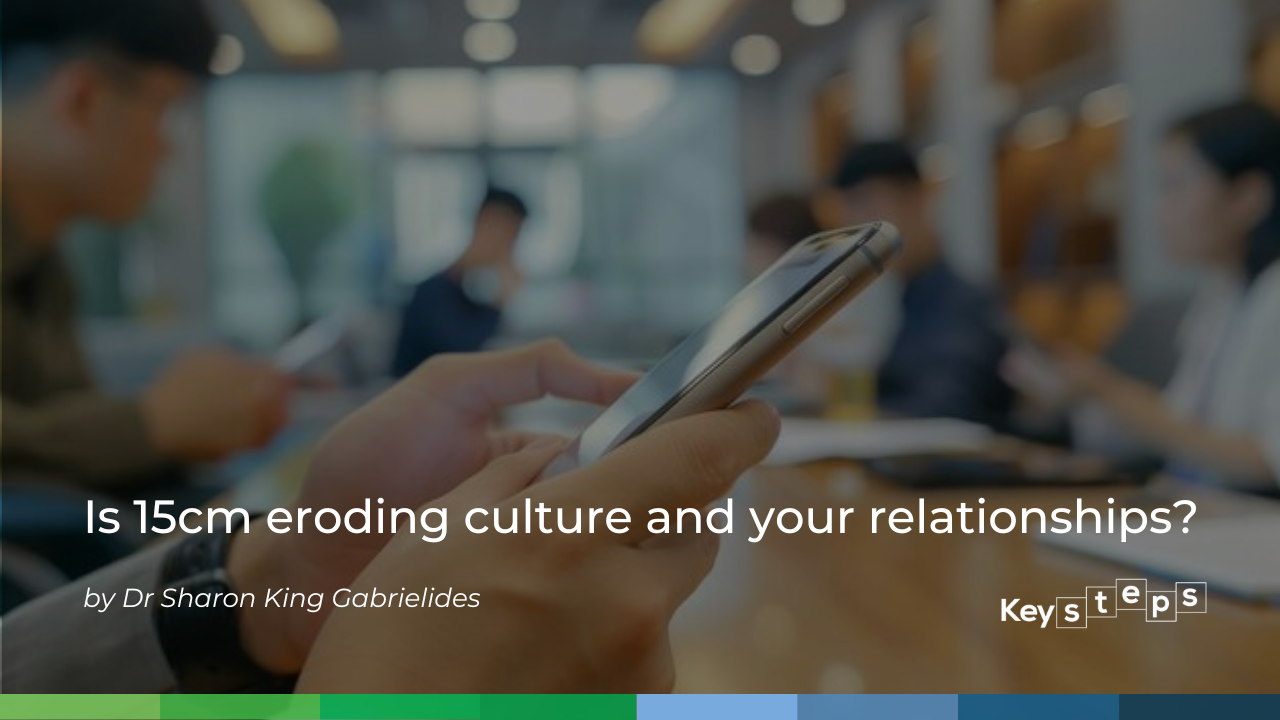
When your mobile triggers a threat response
We underestimate the power of a small approximately 15cm rectangular object…
A mobile on the table.
A glance downward.
A thumb scrolling while someone speaks.
It looks harmless. Efficient. Necessary, even.
But neuroscience tells a more complex story.
Being on your phone while someone is present – especially while they are speaking – can quietly trigger a social threat response in the other person’s brain.
Not irritation. Not annoyance. Threat.
Let’s unpack why and take practical Key Steps to…
‘be the difference that makes the difference.’
- The brain is wired for social safety
Humans are biologically wired for connection. From an evolutionary perspective, belonging equalled survival. Rejection equalled danger. Our nervous system still runs on that ancient coding. When we are in conversation, the brain is constantly scanning for cues that answer three unconscious questions:
- Am I seen?
- Am I valued?
- Does my input matter here?
Neuroscientist Matthew Lieberman’s work in social cognitive neuroscience shows that social exclusion activates the same neural networks as physical pain – particularly the dorsal anterior cingulate cortex. In simple terms:
The brain processes social dismissal like injury. When someone looks at their phone while we are speaking, the brain may interpret that micro-behaviour as withdrawal of attention, status and belonging.
That registers as a threat to social safety. The persons thinking ability literally begins to shut down.
- Attention is a status signal
In leadership psychology and organisational neuroscience, attention is not neutral. Attention communicates hierarchy and value. When someone senior in the room checks their phone, it unconsciously signals:
- “Something else is more important than you.”
- “This interaction is interruptible.”
- “You are not the priority.”
Even if the content is urgent. Even if the intent is harmless. The brain does not decode intention first.
It decodes micro-behaviour. Research from social baseline theory suggests that human nervous systems regulate through co-regulation. Eye contact, presence and attunement calm the amygdala. Divided attention does the opposite. A visible shift of focus away from someone speaking can:
- Increase their cortisol levels.
- Reduce cognitive fluency.
- Undermine confidence.
- Shorten their contribution.
- Activate self-doubt.
All within seconds. Psychologists sometimes refer to this as a “micro-rejection.” It is subtle. Often unconscious. But cumulative. Repeated exposure to micro-rejections in meetings or relationships can lead to:
- Reduced psychological safety.
- Lower engagement.
- Withholding of ideas.
- Defensive communication.
- Emotional withdrawal.
In teams (and families), this becomes cultural. If the most powerful person in the room multitasks, others follow. Attention fragments. Presence erodes. Psychological safety drops. Not because anyone intended harm – but because the nervous system interprets divided attention as relational risk.
- The risk of multitasking and the threat response in action
When someone perceives social threat, even subtly, the body shifts into protective mode:
- Heart rate increases.
- The amygdala activates.
- Working memory reduces.
- Creativity narrows.
- Self-monitoring increases.
Instead of focusing on the message, the speaker – even unconsciously – begins thinking, “Have I lost them? “Is this not good enough? Are they bored?” The cognitive load shifts from contribution to self-protection. And performance drops. Mental bandwidth that should be available for clarity, creativity and strategic thinking is diverted toward managing perceived risk. Performance doesn’t drop because capability disappears. It drops because the brain has shifted into protection mode. In other words, precisely when we are hoping for someone’s best thinking, we may be unintentionally triggering the conditions that limit their access to it.
The risk of thinking… “But we are in a demanding environment and need to multitask”
From a cognitive science perspective, multitasking is largely a myth. What we call multitasking is rapid task-switching. Each switch carries a cognitive cost. Research from Stanford University shows that heavy multitaskers perform worse on tasks involving attention control and memory filtering. But beyond cognitive cost, there is relational cost. The human nervous system detects divided attention almost instantly – through micro-expressions, body orientation and gaze direction. We are exquisitely tuned to it.
When is it not a threat?
Context matters. If someone says, “I need to respond to something urgent – please continue.”
The nervous system relaxes. Why? Because transparency restores predictability and respect. Threat reduces when, the behaviour is explained, the hierarchy dynamic is softened and the person feels acknowledged.
It is not the phone itself that triggers threat. It is unexplained disengagement.
- Leadership SIGNIFICANTLY AMPLIFIES the effect
In leadership roles, behaviour is magnified. A peer checking a phone might register as mild distraction. A CEO doing is much more likely to register as devaluation. This is not about etiquette. It is about neurobiology and power. The more authority you hold, the more your attention becomes symbolic.
Presence from a leader increases: Oxytocin, Trust, Psychological safety, Risk-taking in ideas.
Absence – even subtle absence – reduces your team’s ability to think well, make good decisions and perform at their best.
The cultural consequence
If attention becomes fragmented in a culture, you will see:
- Shorter contributions
- Poorer quality thinking
- Lower creative risk
- Less challenge
- Emotional guardedness
- Reduced discretionary effort
All because the brain does not feel safe. Presence is not a nice to have. It is performance infrastructure.
- Practical and Simple Key Steps
If something urgent arises (when you are at work or at home):
- Name it (aloud).
- Step out if necessary.
- Return intentionally.
- Re-engage visibly.
Or even more powerful: Put the phone face down and out of reach.
That single act communicates, “You matter more than my notifications.”
Humans do not just want efficiency. They want to feel seen.
In a hyperconnected world, attention has become the rarest form of respect.
And the brain knows when it is withdrawn. Your mobile may be small. But in a social nervous system, it is loud.
Put the phone down and take Key Steps to…
‘be the difference that makes the difference.’

