
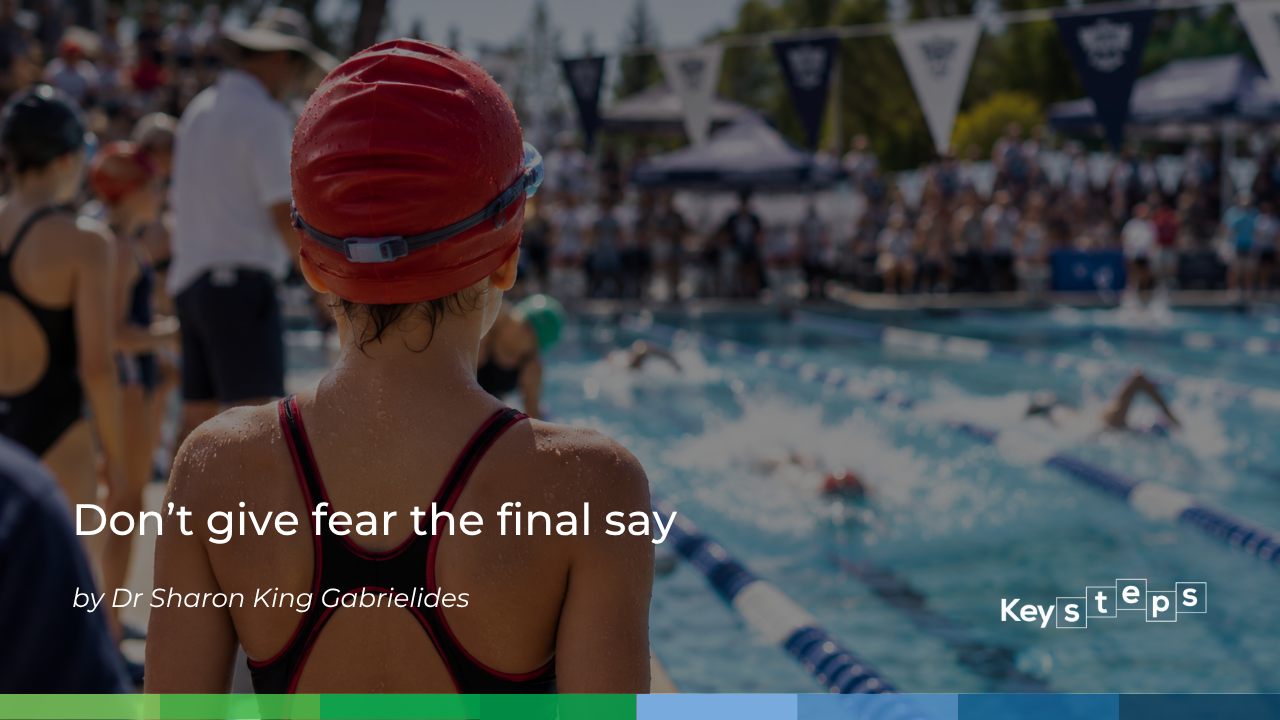
What a school swimming gala reminded me about fear, courage and growth.
Last week, I sat at Mila’s school swimming gala feeling incredibly proud.
Not because I was worried about where she came. And neither was she.
I was proud because, 18 months ago, simply being there would have felt almost impossible for her.
Mila has had to work really hard at doing things that feel scary – particularly in social situations. A swimming gala means being watched, being surrounded by people, lining up, waiting for your turn and stepping forward when every instinct may be telling you to step back.
For some children, that is simply a normal school day. For Mila, it is doing something hard.
And watching her today reminded me of one of the most powerful little words we can teach our children – and ourselves:
Yet.
Not ‘I can’t do this.’
‘I can’t do this yet.’
That tiny word leaves room for growth. It acknowledges that something genuinely is hard right now, without turning where we are today into a prediction of where we will always be.
Over the past couple of years, we have tried to help Mila build that muscle. Reflecting on it today, I think there are three Key Steps that have mattered and can work for us all to…
’be the difference that makes the difference.’
Name the hard thing
Not ‘I can’t do this.’ What exactly feels difficult?
For Mila, it is not really about the swimming. It is the intense sensory stimulation and social exposure around it. It’s the fear of not being able to cope and of being judged.
When we can name what we are afraid of, we turn a general feeling of ‘I can’t cope with this’ into something more specific that we can begin to work with.
Why this matters: Putting feelings into words – sometimes called affect labelling – can help regulate our emotional response. Brain-imaging research has found that labelling an emotion is associated with reduced activity in the amygdala, a region involved in detecting and responding to threat, alongside increased activity in areas of the prefrontal cortex involved in regulation.
Naming the fear does not magically remove it. But it can help us move from simply experiencing the fear to being able to think about it. And that creates space for one very important word: yet.
Make the hard thing small enough to try
Growth rarely comes from one enormous leap. It comes from gradually doing things that stretch us without completely overwhelming us.
For Mila, there have been lots of small steps over the past couple of years. Each one has given her another piece of evidence: ‘I was nervous. I did it. And I was okay.’
Why this matters: Our brains learn from experience. When we expect something to be threatening but experience it safely, the brain has an opportunity to update that prediction. This is one of the principles underpinning exposure-based approaches to anxiety – gradually approaching rather than continually avoiding what frightens us.
Avoidance can bring immediate relief, but it can also reinforce the brain’s original message: ‘That was dangerous. Good thing we escaped it.’
Taking a manageable step creates the possibility of a different message: ‘That was hard. But I coped.’
Repeated often enough, those experiences start to change what we believe we are capable of. That is growth mindset in action. ‘I can’t do this yet’ becomes ‘perhaps I can learn to do this’.
Build evidence that you can
This one feels particularly important today. I genuinely do not care where Mila places in her races.
Right now, the achievement is getting into the pool.
That does not mean the outcome will never matter. As her confidence and capability grow, so will the challenge. Perhaps next time the goal will be to improve her time, refine her technique or push herself a little harder.
But we cannot expect mastery before we have built belief.
Why this matters: Psychologist Albert Bandura’s research on self-efficacy showed that one of the most powerful sources of our belief in our ability to succeed is what he called mastery experiences – actually experiencing ourselves taking action, persevering and making progress.
For Mila, getting into the pool matters today precisely because it makes tomorrow’s harder things more possible.
So, acknowledging the first step is not about lowering the bar or accepting mediocrity. It is about building the belief and behavioural momentum that enable us to raise the bar.
That belief matters because self-efficacy influences whether we approach or avoid difficult tasks, how much effort we invest and how long we persist when things become difficult.
Each successful step becomes evidence: ‘I did that. Perhaps I can do the next thing too.’
The question worth asking
I think there is something here for us as adults too.
The difficult conversation we keep postponing. The presentation that terrifies us. The role we are not sure we are ready for. The boundary we need to set. The change we know we need to make.
Perhaps instead of deciding ‘I can’t do this’, we need to borrow that little word too: yet.
We do not necessarily need to stop feeling afraid before we do the hard thing. Sometimes we need to do the hard thing – gently, incrementally and repeatedly – until our brain has enough new evidence to discover that something that once felt impossible no longer does.
I can feel uncomfortable and still take the next step.
I can be afraid and still do something difficult.
I may not be able to do it yet – but yet is not the same as never.
Today, that next step happened to involve a swimming costume, a school pool and one very proud mommy.
Let’s keep taking Key Steps to…
’be the difference that makes the difference.’

